
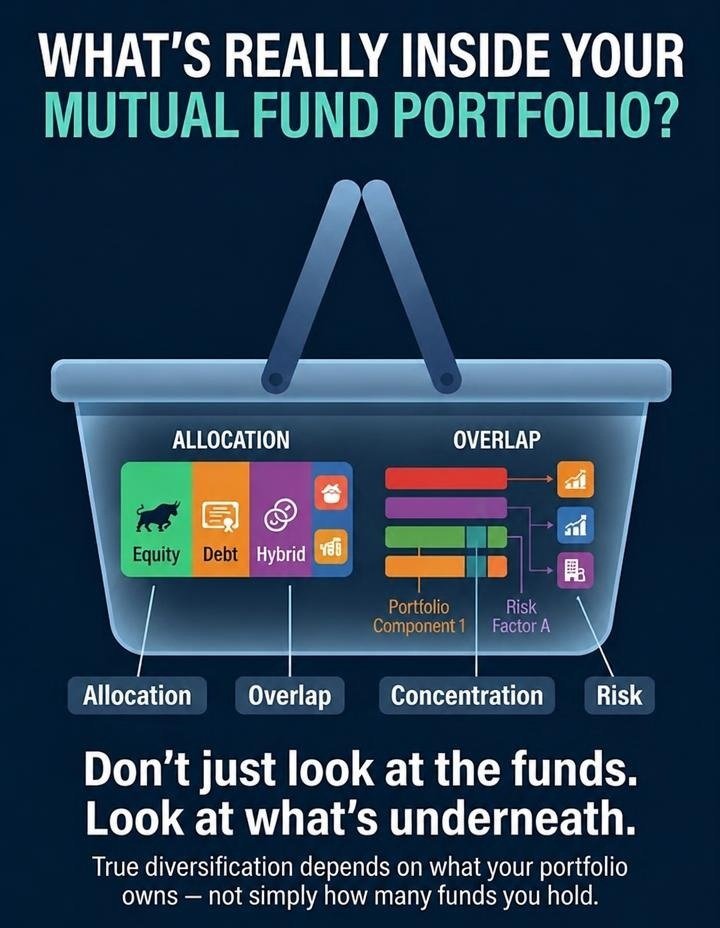
Five, eight, or even ten different funds may be held by an investor, but the portfolio remains poorly diversified. Each fund appears to be well-diversified individually. However, when taken together, these funds could be secretly invested in the same twelve stocks and same two or three industries.
Closing that gap between how a portfolio looks and how it behaves is the purpose of mutual fund portfolio analysis. Instead of judging each fund separately, you ask what the whole collection is doing. A fund can be well run and still be redundant: if you already hold two large-cap funds with near-identical top holdings, a third adds paperwork, not protection. The review works in three passes: allocation, concentration, risk.
Start with allocation
First, work out how much is in equity, debt, hybrid funds and liquid options. No single mix fits everyone. It depends on what you’re saving for, when you need the money and how much volatility you can handle.
Concentration and overlap
Overlap refers to the situation where various funds have similar stocks in their portfolios. If, for example, Fund A is holding X, Y and Z companies at its highest positions, and another fund from another fund house is holding the same three companies at its top positions, then despite an investor’s belief that he has invested in two diversified funds, a crash in the stock of those companies would be detrimental to both.
Similarly, diversification using sector, market cap and thematic concentration strategy also works in the same manner. Thus, the number of schemes has no meaning in this context. Monthly AMC factsheets list top holdings, sector weights and market-cap splits.
Risk and past returns
Past performance tells us what has happened and not how rough the journey was. SEBI mandates that every scheme comes with a risk-o-meter, which is an important beginning, but talks about the scheme and not your portfolio mix. So one should ask oneself: “If it had fallen, would I be able to continue with my investment, and do I require the money?”
Performance numbers in recent times tend to be the most alluring in a factsheet but are often unreliable. What is important is whether the mutual fund still plays an important role in the portfolio.
Where a flexi cap mutual fund fits
A flexi cap mutual fund can invest across companies of different sizes with no fixed percentages, which may suit some portfolios. But a diversified category doesn’t make a diversified portfolio. If you already own a large-cap and a multi-cap fund, another may mostly repeat what you hold, so check its holdings and overlap first.
Do you need a mutual fund advisor?
Taking advice is not mandatory on your part. The value of a mutual fund advisor increases with complexity: multiple objectives, high degree of overlap, uncertain risk tolerance level, or tax and liquidity considerations. If you do choose to go ahead and use the services of an advisor, be clear about the manner in which fees are paid, whether the advisor is an SEBI registered investment adviser or distributor, and also check the registration on SEBI’s website.
Minimum investment isn’t suitability
The mutual fund minimum investment requirement of either ₹100 or ₹5,000 will only give an indication of its accessibility and not whether it should be a part of your portfolio. Minimum requirement being low does not mean that it suits your requirements while a high minimum requirement does not necessarily mean a quality mutual fund. Evaluate each mutual fund based on merit, risk, expense and purpose.
When to review
It is not always necessary to constantly review, because this process may entail additional costs and tax liabilities. The reasons for reviewing could be a significant change in objectives/horizon, changes in risk profile, high concentration, or an unclear investment objective of the fund.
The takeaway
The point of mutual fund portfolio analysis isn’t to find the fund with the highest recent return. It’s to judge whether the portfolio as a whole is sensibly allocated, genuinely diversified and aligned with your goals and capacity for risk, using current data rather than market noise.